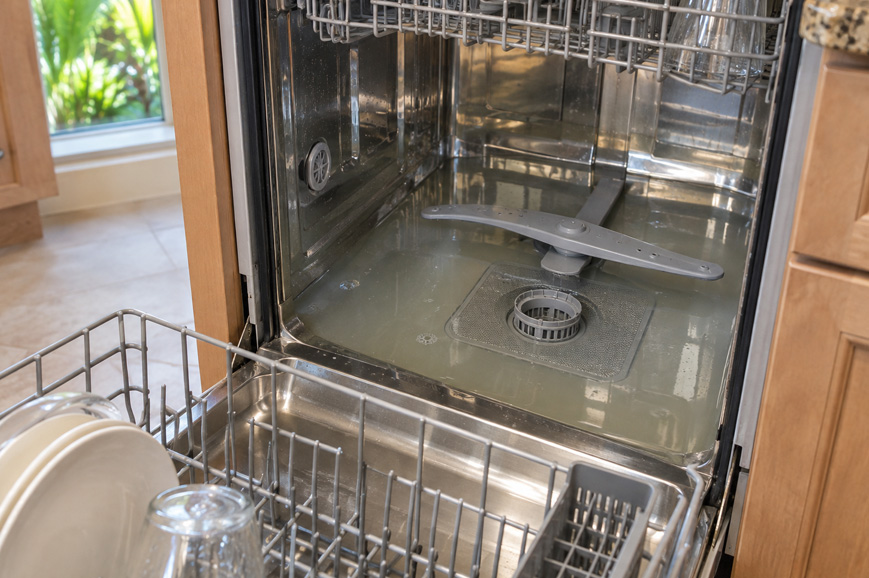
You open the dishwasher to unload the dinner plates and find cloudy water sitting in the bottom. Running it again is tempting. So is ordering a drain pump after watching a repair video. Neither is the best first move.
A dishwasher that won’t drain may have a blockage, an installation problem, or a component that needs repair. Before assuming the machine is finished, a few careful observations can help narrow things down.
For Tampa homeowners getting ready for November guests, this is a problem worth checking before the next full load. Here’s where to start and when to arrange professional service.
Is the water actually abnormal?
The lowest part of a dishwasher does not always dry out completely. A small amount of water in the recessed filter or sump area can be normal. The acceptable amount depends on the model, so compare what you see with your owner’s manual.
GE’s dishwasher drainage guidance explains that normal retained water varies between filter designs. A shallow reservoir below the filter is different from dirty water spreading across the tub floor.
Notice the timing, too. Was the water there immediately after the cycle, or did it return later? Did the dishwasher finish, or did someone open the door halfway through? Those details are useful when you call for service.
Confirm the cycle finished
Look at the display before pressing anything. Photograph an error code or blinking-light pattern so you have a record.
If the cycle was interrupted, follow the manual’s instructions for resuming it or using Cancel/Drain. Controls differ, so there is no button sequence that works for every dishwasher. Stay nearby during this check.
If water remains, avoid repeatedly starting full wash cycles. Stop using the appliance if it leaks or produces a burning smell. Before cleaning inside the tub, disconnect its power at the breaker or an accessible plug and let hot water cool.
Check the sink before blaming the dishwasher
Run a little water in the kitchen sink and watch whether it drains normally. Stop if it starts backing up. A slow sink can point to a shared drain obstruction rather than a failed dishwasher part.
If a functioning garbage disposal shares the connection, operate it according to its instructions to clear ordinary food waste. Never reach inside it.
Also think about recent work. Did this start after a disposal replacement or kitchen remodel? A disposal inlet plug left in place can block dishwasher drainage. Mention that history to the installer or technician rather than disconnecting plumbing to investigate.
Samsung’s drainage troubleshooting guide also recommends checking the sink and disposal connection before moving deeper into the appliance.
Clean a removable filter according to the manual
With power disconnected, check whether your model has a filter intended for homeowner cleaning. Some filters lift or twist out; others should not be removed that way. Don’t force an unfamiliar assembly.
Rinse a removable filter and clean it as directed by the manufacturer. Look for labels, food scraps, or other visible debris nearby, keeping fingers away from concealed openings where broken glass may be present. Reinstall every piece correctly before restoring power.
Filter cleaning is a reasonable maintenance step. It does not prove that every drainage problem is a clog, and it should not turn into taking apart the pump.
Look for a visible hose problem
Inspect the accessible drain hose under the sink without removing connections. Stored cleaning supplies or a trash bin may be pressing against it. Note any obvious kink, damage, or loose connection.
The hose routing matters as well. A high loop or air gap may be part of the installation, depending on the appliance instructions and local requirements. Incorrect routing can allow wastewater to return. If water disappears and then comes back, tell the technician exactly when that happens.
For additional background, Whirlpool’s clogged dishwasher guide covers the filter, drain connections, and installation checks. Leave pulling the dishwasher out or changing its plumbing to someone qualified.
Know when the next step is repair
If the accessible checks do not resolve the problem, schedule a diagnosis. A technician can test the drain pump and controls and inspect parts you cannot safely reach. Humming, silence, or an error code can provide clues, but none identifies a failed part by itself.
DiChristopher offers dishwasher repair in Tampa and surrounding communities, including Carrollwood, Lutz, New Tampa, and Wesley Chapel. Have the brand, model number, error-code photo, and a short description ready when you call.
For November entertaining, our holiday dishwasher guide covers loading and preparation once drainage is working properly. If standing water keeps returning, contact DiChristopher to schedule service before the next gathering.
Frequently asked questions
Is a little water in the dishwasher normal?
Yes. Some models retain water in the recessed filter or sump area after a cycle. Check your manual for what is normal for your machine. Dirty water covering the tub floor, a rising level, or a change from its usual behavior deserves attention.
Can I put drain cleaner in my dishwasher?
No. GE specifically advises against using drain cleaner in a dishwasher. Use only cleaning products and methods approved for your model. If the kitchen sink is also backing up, stop running the dishwasher and have the shared drain checked rather than adding chemicals to the appliance.
Why won’t my dishwasher drain after a new garbage disposal was installed?
The disposal’s dishwasher inlet may still have its knockout plug installed. That would block the dishwasher’s drain connection. A pinched or incorrectly routed hose is another possibility. Contact the installer and explain that the drainage problem began immediately after the disposal was replaced.
Does a humming dishwasher mean the drain pump is bad?
Not necessarily. A sound alone does not confirm pump failure. A technician needs to check drainage restrictions and test the relevant components before recommending a replacement. Record when the sound occurs and whether any water leaves during the drain portion of the cycle.
Should I call a plumber or an appliance repair company?
If the kitchen sink also drains slowly or backs up, a plumber may be the right first call. If the sink drains normally but the dishwasher repeatedly retains excessive water, arrange appliance service. Describe both appliances’ behavior when booking so the provider can advise you.